Lab-Grown Salmon Is Here. But Are We Solving the Wrong Problem?
Oct 08, 2026
Lab-grown salmon is no longer some futuristic idea.
In May 2025, Wildtype completed the FDA's premarket consultation process for its cell-cultivated coho salmon. The FDA concluded that it had no questions regarding the company's determination that its cultivated salmon cell material was safe under its intended conditions of use.
And now it's being served in restaurants.
When I started looking deeper into this, my first thought wasn't:
“Would I eat it?”
My question was:
Why are we normalizing engineering food instead of making real food more accessible?
As a holistic nutritionist and plant-based chef, that's the conversation I think we need to be having.
What Did the FDA Actually Review?
Before we go any further, there's something important I want you to understand about the FDA's decision.
When you hear that the FDA has “cleared” lab-grown salmon for human consumption, you might assume the agency conducted its own independent studies to determine whether this product is safe.
That's not exactly what happened.
Wildtype (the company manufacturing this cultivated salmon) conducted its own safety assessment and submitted its findings and supporting scientific data to the FDA.
The FDA reviewed the company's submission, considered other available informationnand issued what's called a “no questions” letter on May 28, 2025.
In other words, based on the information reviewed, the FDA did not identify a reason to reject Wildtype's conclusion that its cultivated salmon cell material was safe under its intended conditions of use.
Now, let's be clear about what that means.
The FDA conducted a scientific evaluation. But it was largely based on information generated and submitted by the company seeking to bring the product to market.
That is not the same thing as the FDA conducting independent, long-term human studies on the effects of consuming cultivated salmon.
And there's another detail I think deserves attention.
In its response letter, the FDA specifically explained that its evaluation of nutrients used during production focused on safety - not on their impact on the nutritional quality of the food supply.
The agency also stated that its consultation covered the production process through the harvesting of the cultivated cells. Subsequent processing of those cells into finished food products was outside the scope of that particular consultation.
So when we hear the words “FDA cleared,” I think it's important that we understand exactly what was evaluated and what wasn't.
As a holistic nutritionist, those distinctions matter to me.
Because meeting a regulatory safety standard and demonstrating long-term nutritional benefits are two very different things.
And I believe consumers deserve to understand that difference before deciding what belongs on their plates.
What Exactly Is Lab-Grown Salmon?
Let's start with what we're actually talking about.
Wildtype's cultivated salmon begins with cells originally taken from a juvenile Pacific salmon.
Those cells are grown and multiplied in controlled cultivation systems where they're supplied with nutrients that allow them to grow.
The cells are then harvested and combined with other ingredients to create a product designed to provide the taste and texture people associate with salmon.
So we're not talking about a salmon swimming in the ocean.
We're not talking about a farm-raised salmon, either.
We're talking about growing salmon cells and then using those cells as part of a manufactured food product. That manufactured product contains everything from carrageenan (which has been linked to intestinal inflammation) to "natural flavors".
This is exactly why I encourage people to look beyond the marketing and understand how their food is manufactured.
They are not simply growing a salmon fillet. They are combining cultivated animal cells with other ingredients to recreate the experience of eating one.
Wildtype's cultivated salmon currently contains just 4–5 grams of protein per 2-ounce serving, compared with approximately 12–14 grams in conventional salmon.
So while the finished product may resemble salmon in appearance and taste, it doesn't currently deliver the same amount of protein or nutrients.
And I think consumers deserve to know that.
We're being told that this represents the future of food. But I have questions.
You May Never See the Words “Lab-Grown Salmon”
This is probably one of the most important things I want consumers to know.
If you're waiting to see a menu or package with the words “LAB-GROWN SALMON” written across it, that's not necessarily the terminology you're going to encounter.
Instead, learn to recognize terms such as:
-
Cultivated
-
Cell-cultivated
-
Cell-cultured
-
Cultured
-
Cell-based
Wildtype itself says it uses the terms “cell-cultivated” and “cultivated.”
The FDA refers to the material it reviewed as “cultured salmon cell material.” Importantly, the FDA also states that its terminology should not be interpreted as a recommendation for what companies should call these products on consumer labels.
So this is still an evolving area of food labeling.
That's exactly why consumers need to learn the language now.
If you see cultivated salmon, cell-cultivated salmon, cell-cultured seafood or cell-based seafood, don't automatically assume you're looking at conventionally caught or farm-raised seafood.
Stop.
Read.
Ask questions.
And read the ingredient list when one is available.
You deserve to understand what you're eating.
It's Already Being Served in Restaurants
This isn't something sitting in a laboratory waiting for some distant future.
People are already eating it.
As of October 2026, Wildtype's published restaurant information lists its cultivated salmon at:
-
Kingfisher — Tucson, Arizona
-
Robin — San Francisco, California
-
The Walrus and the Carpenter — Seattle, Washington
-
barmini by José Andrés — Washington, D.C.
Wildtype initially launched its cultivated salmon at Kann in Portland, Oregon, in 2025. OTOKO in Austin also served the product before cultivated meat became prohibited in Texas.
This is not currently some massive national restaurant-chain rollout. The number of restaurants is still small.
But that's exactly why I think now is the time for consumers to understand what's happening, not five years from now when these products may be much more common.
Know the terminology.
Read menus carefully.
And if you're unsure, ask:
“Is this conventional salmon, farm-raised salmon or cell-cultivated salmon?”
There is nothing wrong with asking where your food came from.
Could Lab-Grown Salmon Be Coming to Grocery Stores Next?
As of October 2026, Wildtype's cultivated salmon has not been confirmed for sale in U.S. grocery stores. Its rollout has focused on select restaurants.
However, Wildtype has identified major retailers such as Costco, Trader Joe's and Walmart as examples of stores it hopes to reach in the future.
Whether you're reading a restaurant menu or shopping at your neighborhood grocery store, learn to recognize terms like “cultivated,” “cell-cultivated” and “cell-cultured.”
Because knowing what's in your food and how it was produced should never be an afterthought.
What's Actually in Cultivated Salmon?
This is another part of the conversation that gets lost when we simply call the finished product “salmon.”
Wildtype explains that after its cultivated salmon cells are harvested, they're combined with additional ingredients to create the finished product.
Its ingredient information describes cell-cultivated salmon along with ingredients including water, fats derived from algae and sunflower, emulsifiers and soy protein.
Some Wildtype products contain additional ingredients used to create structure, texture and flavor.
That distinction matters to me.
Because when I talk about moving toward whole foods, I'm talking about moving toward foods that require less intervention, not increasingly sophisticated systems for reconstructing foods we already have.
We Don't Have a Shortage of Technology
This is where my biggest issue lies.
We have communities where people struggle to access fresh produce.
We have families struggling to afford groceries.
We have neighborhoods where highly processed convenience foods are easier to find than fresh fruits and vegetables.
We have people who were never taught how to prepare beans, lentils, greens, whole grains and other inexpensive, nutrient-dense foods.
Those are food-system problems.
Meanwhile, enormous amounts of money, research and technology are being invested into figuring out how to grow animal cells and turn them into marketable food products.
And I keep coming back to the same thought:
We don't have a shortage of technology. We have a shortage of affordable, accessible, nutrient-dense whole food.
Imagine what this level of innovation and investment could accomplish if we became equally obsessed with solving THAT problem.
When Did More Engineering Become the Answer to Everything?
Walk through the average grocery store and look around.
We've already taken foods and refined them, isolated them, concentrated them, reconstructed them, flavored them and packaged them until many products barely resemble the ingredients they started with.
Now we're entering another era.
Instead of simply processing foods that already exist, we're developing systems for growing animal cells and constructing foods around them.
Supporters of cultivated meat and seafood point to potential benefits involving sustainability, overfishing, animal welfare, contamination and feeding a growing population.
I understand those arguments.
But something can be technologically impressive without being the direction I believe our food system should go.
Technological advancement and nutritional progress are not automatically the same thing.
I want to see us moving closer to whole foods not creating increasingly complicated ways of manufacturing food.
What About the Nutrition?
Another assumption we shouldn't automatically make is that something engineered to resemble a food will always be nutritionally identical to that food.
During its scientific evaluation of Wildtype's cultivated salmon cell material, the FDA noted that its mineral profile was generally comparable to conventional coho salmon but that there were modest decreases in iron, magnesium, potassium and selenium.
That doesn't mean those differences automatically make the product harmful.
But it illustrates something I believe we've forgotten:
Food is complicated.
Whole foods aren't simply protein, carbohydrates, fat, vitamins and minerals that can be assembled like pieces of a puzzle.
From a holistic nutrition perspective, reducing food entirely to the nutrients we've identified and measured misses the bigger picture.
That's one of the reasons I've always encouraged people to build their diets around whole and minimally processed foods.
My Concern Is Bigger Than One Piece of Salmon
This isn't really about one salmon product.
It's about the direction of our food system.
If every problem becomes an opportunity to create another engineered product, another proprietary technology and another manufacturing process, eventually we need to ask:
Are we actually building a healthier food system or simply a more technologically advanced one?
Because those are not necessarily the same thing.
I'd rather see massive investment in:
-
Regenerative and sustainable agriculture
-
Local farmers
-
Community gardens
-
Nutrition education
-
Better access to fresh produce
-
Teaching people how to cook
-
Making fruits, vegetables, beans, lentils, whole grains, herbs, nuts and seeds affordable and accessible in every community
That's the food revolution I want to see.
Maybe the Future of Food Doesn't Need to Be More Complicated
My philosophy around food has always been pretty simple:
Eat more real food. Eat more plants. Eat foods as close to their natural state as reasonably possible.
So no, cell-cultivated salmon isn't something I'm interested in putting on my plate.
And I want consumers who feel the same way to understand the terminology so they can make informed decisions for themselves.
Remember these words:
Cultivated. Cell-cultivated. Cell-cultured. Cell-based.
Pay attention to ingredient lists.
Ask restaurants where their food comes from.
And don't be afraid to question where our food system is headed.
Because maybe the revolutionary thing isn't figuring out increasingly sophisticated ways to manufacture food.
Maybe it's finally building a food system where everyone can afford and access the nourishing foods that already exist.
We've normalized engineering food instead of making real food more accessible.
And THAT is the problem I think we should be talking about.
Sources and Further Reading
About the Author
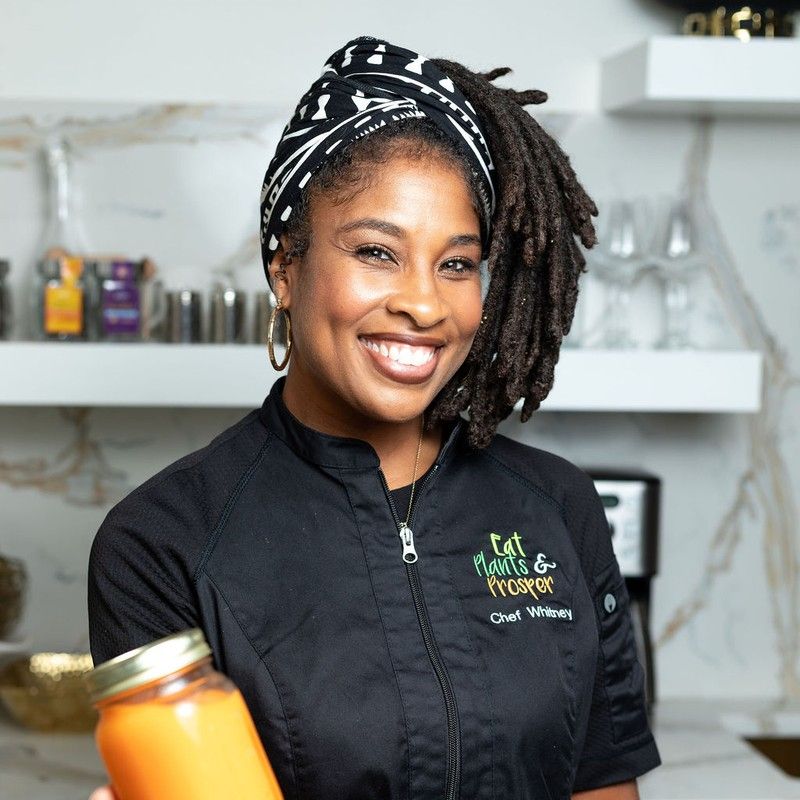
Whitney Miner is a Certified Holistic Nutritionist, Certified Yoga Instructor, Plant-Based Chef, and Founder of Eat Plants & Prosper, a holistic wellness brand dedicated to helping people improve their health through plant-based nutrition, herbal wellness and mindful living.
Through nutrition education, wellness coaching, plant-based cooking, and holistic lifestyle practices, Whitney empowers individuals to take a proactive approach to their health and make sustainable changes that support long-term well-being.
You're Invited.
Join the Eat Plants & Prosper community and get weekly plant-based recipes, wellness tips, and nourishing inspiration delivered straight to your inbox.